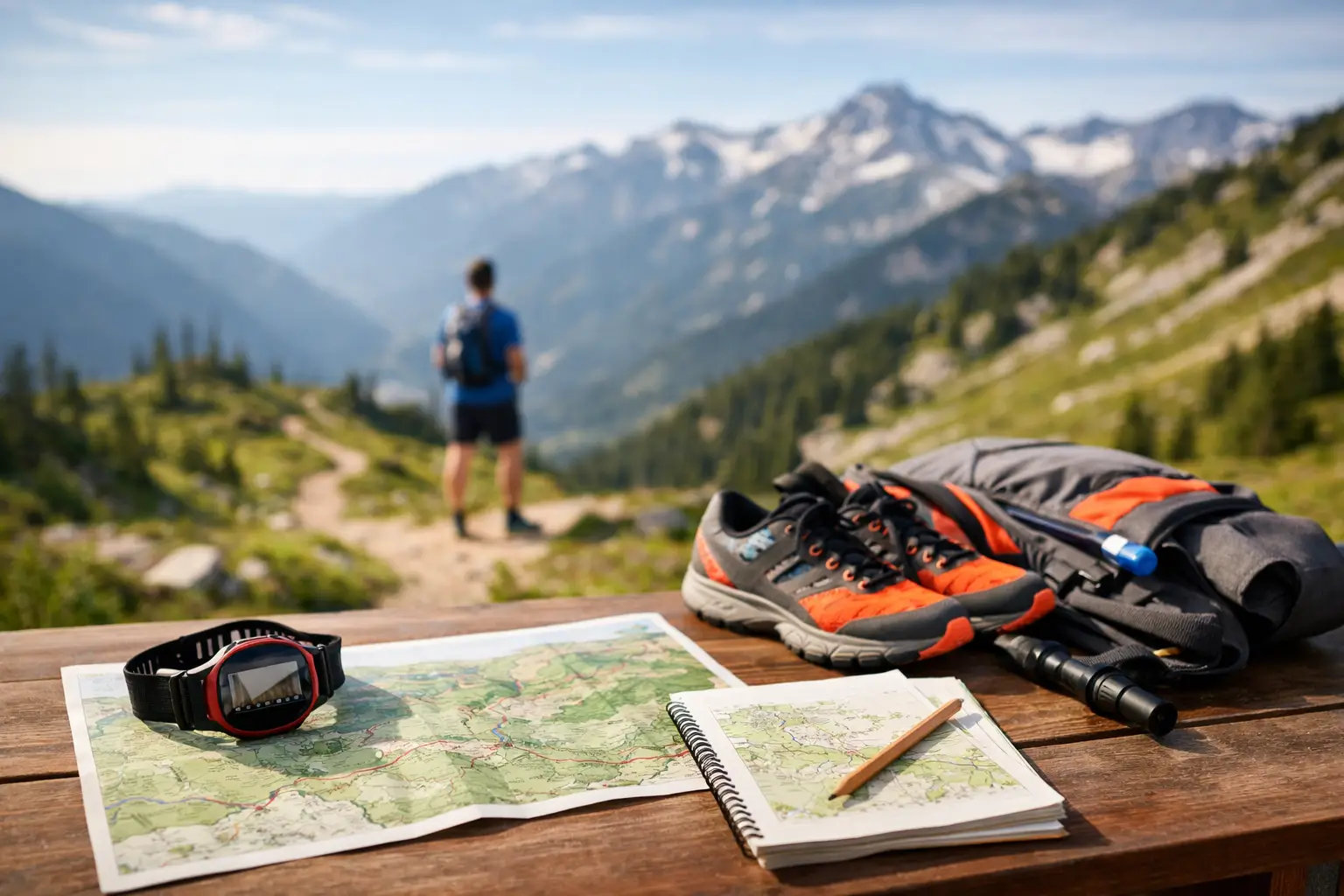
You do not lose most trail races on race day. You lose them two weeks earlier, when you guessed at the climbs, skimmed the aid station chart, and assumed the course would run like the distance on paper. A good trail race planning guide fixes that. It turns a course from a vague line on a map into something you can actually race.
Trail running punishes bad assumptions. A runnable fire road climb and a steep technical hike can share the same elevation gain, but they do not cost the same. An aid station at mile 22 means very little if the 7 miles before it are exposed, slow, and dry. Planning is not about controlling every variable. It is about removing avoidable mistakes before the gun goes off.
What a trail race planning guide should actually do
Most runners already know the basics. Check the distance. Check the elevation. Look at the cutoff times. That is not enough once the course gets serious.
A useful trail race planning guide should help you answer race-specific questions. Where are the long climbs that will force a power hike? Which descents will trash your quads if you get greedy early? Where do terrain changes shift your pace assumptions? Which aid stations matter for calories, bottles, layers, or crew access? If your planning does not answer those questions, it is still too shallow.
The goal is simple - know the route well enough that race day feels familiar. Not easy. Familiar.
Start with the course, not the race marketing
Race websites often tell you just enough to register and not enough to execute. The map may be simplified. Elevation profiles can smooth out sharp pitches. Mileage between key points may be inconsistent across pages. If you build your strategy from the event description alone, you are planning off highlights, not details.
Start with the most exact version of the course you can get. That usually means a GPX file and a map view detailed enough to inspect turns, terrain patterns, and where climbs truly begin and end. Once you have that, break the route into meaningful sections.
Do not divide the course into equal mileage chunks. Trail races are rarely raced that way. Divide it by effort and consequence. A 5-mile section with smooth singletrack is one kind of problem. A 5-mile section with steep climbing, creek crossings, and heat exposure is another. Your body will treat them differently, so your plan should too.
Read the elevation profile like a racer
Elevation gain is the headline number. Grade distribution is what matters.
Two races with 8,000 feet of climbing can race completely differently. One may have long steady ascents where you can lock into a rhythm. Another may stack short, sharp climbs that repeatedly spike effort and break momentum. Look for where the steepest grades occur, how long they last, and whether they arrive early or late.
Also study the descents. Runners tend to focus on climbing cost and ignore downhill damage. If the race has long technical descents in the back half, your pacing plan should protect your legs before you get there. If the opening descent is fast and smooth, that is a trap as much as an opportunity.
Look for terrain transitions
Courses are often won or lost where terrain changes. Fire road to rocky ridge. Forest singletrack to exposed climb. Dry dirt to mud. These transitions affect pace, fueling, footing, and mental rhythm.
Mark the spots where the course changes character. Those are the moments where runners make bad decisions because the effort suddenly feels different. If you know those shifts are coming, you stay ahead of them instead of reacting late.
Build your pacing plan around aid stations and cutoffs
Pacing in trail racing is not a flat target pace. It is a section-by-section effort plan tied to terrain and logistics. That matters even more in ultras, where aid station execution can save or wreck a race.
Use aid stations as your planning framework. They are natural checkpoints for time, fluids, calories, gear, and mental reset. Instead of asking, "What pace do I need for 50K?" ask, "What effort and split makes sense from Start to Aid 1, Aid 1 to Aid 2, and so on?"
This is where many runners get in trouble. They project road-style pace consistency onto a course that does not allow it. Then they hit the first major climb behind schedule, overcorrect, and burn too much energy trying to get time back. A better approach is to assign realistic ranges to each segment based on climbing, footing, altitude, and your own strengths.
Cutoffs should be part of that plan, even if you expect to beat them comfortably. Back-of-pack runners need them for survival. Front- and mid-pack runners need them because races unravel. Heat builds. cramping starts. A wrong turn costs minutes. If you know your cushion at each aid station, you make calmer decisions when something goes sideways.
Plan nutrition and fluids by section, not by hour alone
Hourly fueling targets are useful, but the course decides how easy they are to hit.
A steep, technical climb may make it hard to chew or reach for food. A smooth descent may be the best section to catch up on calories. A long exposed stretch between aid stations changes how much fluid you need to leave with. If your nutrition plan ignores terrain and spacing, it is incomplete.
Work through the course and identify where you can realistically eat, drink, and refill. Note the long gaps between aid stations. Note the sections where heat, altitude, or effort will increase fluid demand. Then decide where you need to carry extra capacity and where you can move lighter.
This is also where course familiarity pays off. If you know the next aid station sits at the top of a 40-minute climb instead of after a runnable traverse, you will leave the previous station with a different mindset and probably a different bottle plan.
Navigation matters even on marked courses
A marked trail race is not the same thing as a foolproof trail race.
Course markings get missed. Volunteers give broad directions, not precision. Fatigue narrows attention. In bad weather or darkness, obvious turns stop being obvious. Even a short off-course error can cost time, energy, and composure.
That is why serious runners still review the route closely and carry course data on a watch or phone that works offline. You do not need to stare at a map all day. You need enough course intelligence to recognize critical junctions, understand where confusion is likely, and confirm that you are still on track before a mistake gets expensive.
TrailSight is built for exactly this kind of prep - studying the course in detail before race day, then carrying usable route intelligence into the field.
Do your gear planning from the terrain backward
Gear should match the course you are racing, not your default setup.
If the course has repeated steep hiking, poles may be worth the weight and hassle. If the descents are loose and technical, shoe choice matters more than it would on buffed-out singletrack. If weather can shift fast above tree line, your shell is not a box-check item. It is a pacing tool, because getting cold changes how hard you can run.
The same applies to packs, bottles, lights, and layer strategy. Think through where each item becomes useful, not just whether it might be useful at some point. That keeps your kit practical instead of bloated.
Test the plan before race week
A plan that only exists in your head is not ready.
Use long runs and race-specific workouts to test pieces of it. Practice climbing at planned effort. Rehearse your fueling with the actual products and carry setup you will use. Load the route file onto your watch and confirm it behaves the way you expect. If you are using poles, train with them. If you are planning on quick aid station exits, rehearse bottle swaps and calorie access.
This is where trade-offs get real. The most detailed pacing plan in the world is useless if your fueling is too ambitious to execute or your watch setup drains battery early. Better to simplify the plan in training than discover its weak points at mile 35.
A smarter trail race planning guide leaves room for adjustment
Preparation is not rigidity. It is having a baseline strong enough that you can adapt without panic.
Weather may change the course. Mud may slow descents. Heat may force a more conservative opening. Your race plan should include that possibility. Know which sections are safe to press and which ones punish overreach. Know where you can claw back time and where trying will only compound the damage.
That is the real value of planning. You are not trying to predict the day perfectly. You are reducing uncertainty so your decisions get better under stress.
Run it like you have already been there. That is how you turn a course profile into an actual race advantage.