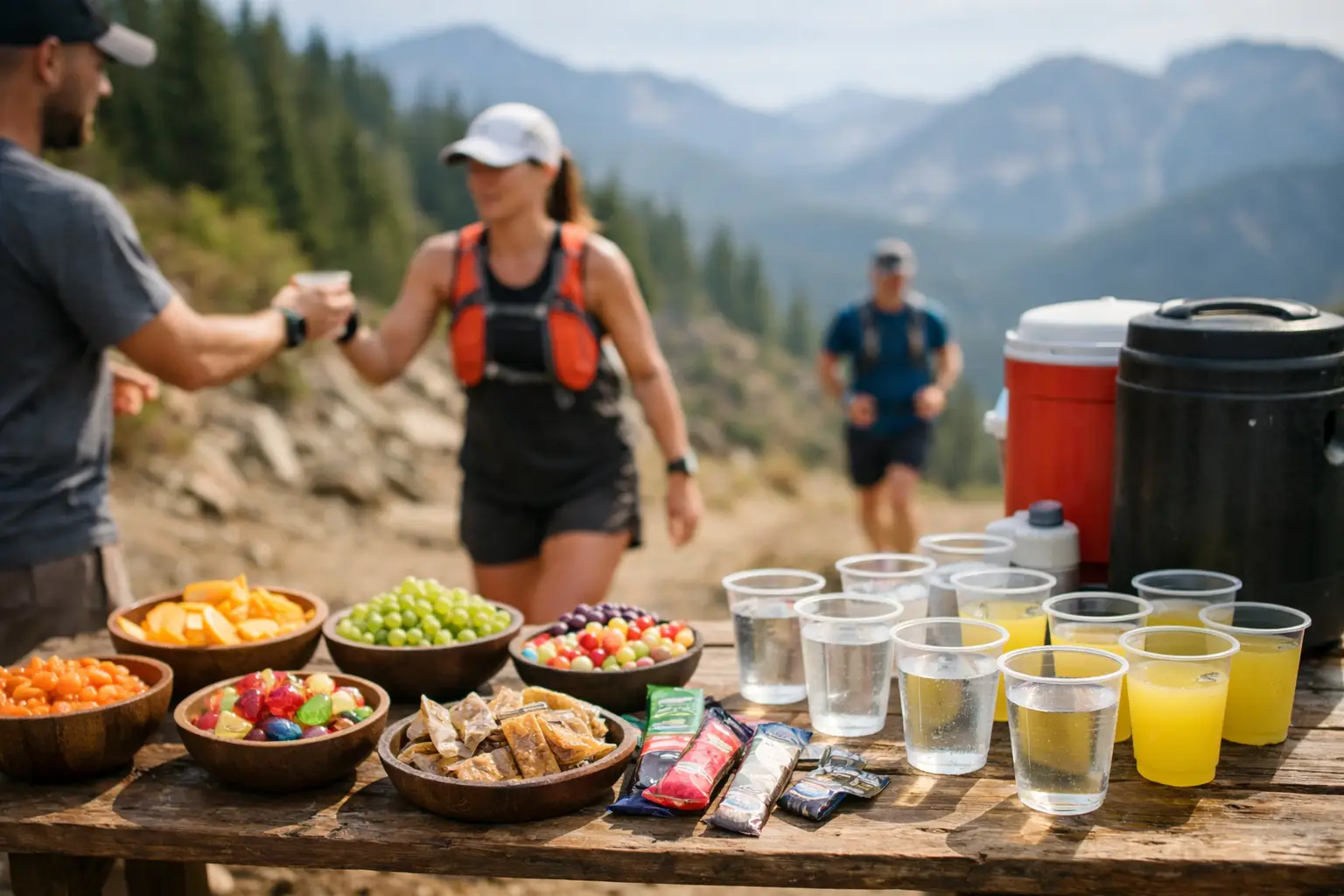
A lot of races are lost standing still.
Not on the climb. Not on the descent. At the aid station, with cold hands, a foggy head, and no clear plan for what goes in, what stays on your body, and what gets skipped. That is why trail race nutrition stop planning matters. If you wait until race morning to figure out bottles, calories, sodium, or drop bag timing, you are already behind.
Trail races punish vague plans. Aid stations are unevenly spaced, climbing slows intake, heat changes fluid demand, and late-race decision-making gets worse, not better. A road marathon fueling plan does not transfer cleanly to a mountain course. You need to build nutrition around the actual route.
What trail race nutrition stop planning really means
This is not just deciding which gels to carry. Trail race nutrition stop planning means matching your intake strategy to the course structure - where aid stations sit, how long each segment takes, what terrain separates them, and how your effort changes from one section to the next.
A 7-mile segment can be quick and runnable or it can be a steep, exposed grind that takes twice as long as expected. That difference changes everything. It affects how much fluid you leave with, how many calories you need on your body, whether one flask is enough, and whether stopping to refill will cost less time than carrying extra weight from the start.
Good planning also accounts for what happens when the race goes sideways. You miss a bottle refill. Your stomach turns on a hot climb. The aid station food looks good at mile 40 but useless at mile 70. A solid plan gives you options before you need them.
Start with aid station spacing, not product choice
Most runners begin with brands, flavors, and calorie targets. That matters, but it is not the first step. Start with the aid station chart and the course profile.
Look at the distance and expected time between every stop. Then look at the vertical gain, altitude, exposure, and technicality in each segment. A flat 90-minute stretch and a rocky 90-minute climb may require different intake even if the clock time is similar. One lets you eat. The other may force you into liquid calories and smaller, more frequent doses.
This is where race-specific course data matters. If you know where the long climbs start, where runnable terrain returns, and where cutoffs tighten, you can build a fueling plan that fits the race instead of forcing the race to fit your habits.
For shorter trail races, the plan may be simple. One stop, one refill, minimal decision-making. For ultras, every station becomes a checkpoint in a larger system. Bottles, sodium, caffeine, backup calories, and drop bag changes all need to line up with the terrain ahead.
Plan by segment, not by race total
Saying you need 250 calories per hour and 20 ounces of fluid per hour is a starting point, not a full strategy. Trail running is too variable for clean hourly math alone.
Break the race into aid-station segments and assign each one a realistic duration. Then decide what you need to leave each station with. That usually means a fluid volume target, a minimum calorie amount on your person, and a backup item in case you cannot tolerate your primary fuel.
This approach does two things. First, it keeps you from overpacking early and carrying unnecessary weight uphill. Second, it reduces the risk of leaving underfueled for a long section because the mileage looked short on paper.
A practical example helps. If segment one is 55 minutes on cool, runnable trail, one bottle and light calories may be enough. If segment two is 2 hours and 10 minutes with exposed climbing, you may need full bottles, extra sodium, and calories that are easy to get down when breathing hard. Same race. Very different stop plan.
Match intake to terrain
Terrain changes how easy it is to fuel. Smooth fire road lets you chew and drink on schedule. Steep grades, technical descents, stream crossings, and high-consequence footing can disrupt that rhythm.
That means you should not just ask, how much do I need? Ask, where can I actually take it in?
Many runners do better front-loading calories before a major climb, then relying on fluids and simpler fuel during the harder section. Others use descents or flatter connectors to catch up on missed intake. The right move depends on your stomach, your pace, and how technical the course is. The key is planning those windows in advance.
Match intake to station type
Not every aid station offers the same support. Some are full-service with water, sports drink, hot food, and crew access. Others are basic, fast, and limited.
Your stop plan should reflect that. A major station may be the place to swap bottles, reload fuel, grab real food, and reset for the next long push. A minor station may be nothing more than a fast refill and go. Treating every stop the same wastes time and creates unnecessary decisions.
Build for the race you will run, not the race you hope to run
This is where many plans fall apart. Runners estimate aid-station arrival times based on best-case splits, then carry too little for slower segments. Or they assume cool weather and get caught short in heat.
Be honest about your likely pace on climbs, your refill speed, and your intake under fatigue. If a section could take anywhere from 90 minutes to 2 hours depending on conditions, plan closer to the slower end unless there is a clear reason not to. The small weight penalty is usually cheaper than the performance hit from running low.
The same applies to stomach tolerance. If your ideal plan says 300 calories per hour but you only manage that in training on moderate terrain, do not force it on race day in steep heat. Better to execute 220 consistently than chase a target you abandon after two stations.
Use drop bags to simplify decisions
Drop bags should reduce risk, not create more choices.
For longer races, place fuel and hydration supplies where the course demands change. That might be before a hotter section, ahead of a longer gap between aid, or at the point where you typically shift from sweet fuel to savory food. Keep the contents clean and specific. Restock the exact items you expect to use, plus one backup option if your stomach is fading.
Avoid turning a drop bag into a small gear store. When you are tired, too many options slow you down. You want a short script: swap flasks, grab labeled fuel, take sodium, move on.
If crew support is allowed, the same rule applies. Crew should know the segment plan, not just hand you random food and ask what sounds good.
Trail race nutrition stop planning should include time cost
Aid stations are not free. Even efficient stops add up, especially late in ultras when focus drops and simple tasks take longer.
That does not mean rushing every station. It means knowing which stops deserve time and which do not. Spending an extra 60 seconds at a major station to refill correctly and leave with the right calories can save far more time than stumbling into the next section underprepared. On the other hand, standing around at a minor station because you have not decided what you need is avoidable loss.
A good stop plan includes a purpose for each station. Refill only. Refill plus food. Drop bag reset. Crew change. If you know the job before you arrive, you move faster.
Test the system in training
The smartest trail race nutrition stop planning still needs field testing. Use long runs and race-specific training days to practice segment-based fueling. Carry what you expect to carry. Refill when you would refill. Eat on the terrain where you expect to eat.
This is where problems show up. Maybe your powder concentration is too strong for long climbs. Maybe opening wrappers with wet hands is a mess. Maybe one bottle is enough in cool weather but not once sun exposure kicks in. Those details matter because they become bigger under race stress.
If you use a race-planning platform like TrailSight, this is where the advantage shows up. Seeing station spacing, terrain transitions, and estimated segment demands in one place makes it easier to rehearse the real plan instead of guessing from a PDF and a vague elevation chart.
Keep the plan simple enough to use when tired
Complex plans look strong on paper and fail at mile 50.
Your nutrition stop plan should be detailed in preparation and simple in execution. Know the segment times. Know the station roles. Know what leaves each stop with you. Then reduce that into a format you can use when your brain is running low.
The best plans are usually boring. One bottle water, one bottle mix. Two gels before the climb. Refill at the next station. Grab backup chews from the vest pocket if solid food stops working. Repeat with small adjustments as conditions change.
That is the point. You do not want to think your way through every stop. You want to arrive, execute, and get back on trail with what the next section demands.
The race will still get messy. Weather shifts. Pace changes. Stomachs go bad. But if you have mapped your aid stations to time, terrain, and intake before race day, you are not reacting blind. You are making small adjustments inside a system that already fits the course. That is how you stay fueled, keep moving, and run the second half with something left to race.