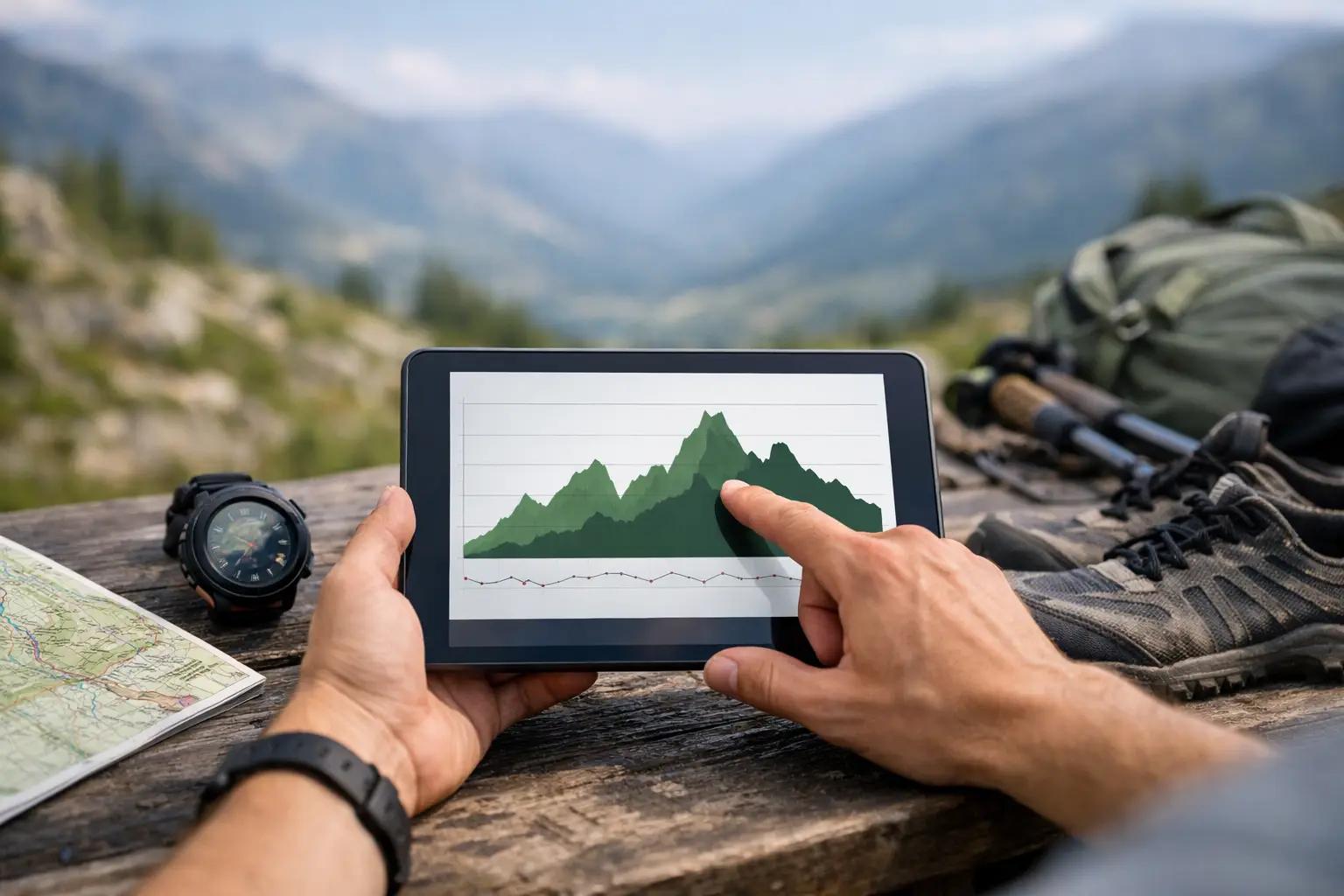
A trail race elevation profile can tell you where your day will go sideways long before the starting horn. One glance should show more than total gain. It should tell you where to hold back, where to eat, where the course gets expensive, and where bad pacing choices start stacking up.
That matters because plenty of runners still treat the profile like race-poster art. They look at one giant climb, one scary descent, and a finish line on the far right. Then race morning shows them what the graphic really meant. Legs are gone by mile 20, fueling is off, and a cutoff that looked generous suddenly is not.
What a trail race elevation profile actually shows
At the simplest level, an elevation profile plots distance on the horizontal axis and elevation on the vertical axis. That sounds basic, but the value is in how those two axes work together. You are not just seeing how high the course goes. You are seeing when the climbing happens, how long it lasts, how quickly the terrain changes, and whether descents offer recovery or just more damage.
A useful profile helps answer race-day questions fast. Is the first hour runnable or already steep? Are the biggest climbs evenly distributed or back-loaded? Do the descents come on tired legs? Are aid stations placed before a major climb, after it, or in the middle of a long exposed section? Those answers shape pacing, fueling, gear, and cutoff strategy.
The problem is that many race profiles flatten reality. Vertical scale can make brutal climbs look gentle. Low-resolution charts hide repeated rollers that chew up time. Some profiles show only the broad outline and miss what your quads will actually feel. So the profile is not the whole course. It is the starting point for understanding it.
Why the trail race elevation profile matters more than total gain
Two races can both advertise 8,000 feet of climbing and race nothing alike. One may spread that gain across smooth, runnable grades. The other may deliver it through short, sharp walls with technical descents between them. Same total gain. Very different demands.
That is why serious prep starts with shape, not just numbers. A course with one major sustained climb rewards patience, steady output, and simple nutrition timing. A course with constant sawtooth climbing punishes rhythm and makes fueling harder because intensity keeps changing. A course with a mild first half and a loaded second half can bait runners into racing the wrong event for 20 miles before the real work starts.
If you only remember total elevation gain, you miss the cost of where that gain lives.
How to read the shape, not just the chart
Start by breaking the course into race segments. Look for the opening third, the middle grind, and the final decisive section. Most profiles become more useful when you stop viewing them as one line and start viewing them as a sequence of problems.
A long early climb usually demands restraint. Even if it is technically runnable, that does not mean it is worth running at race effort. If the first major ascent starts inside the opening miles, ask whether the race is forcing intensity before your fueling has settled. That often decides whether running is smart or just emotional.
Middle sections deserve more attention than they get. This is where races are often lost quietly. Not on the biggest climb, but on repeated moderate climbs and descents that never feel dramatic enough to respect. A profile that looks "rolling" can still be a leg trap if the rollers are relentless and arrive after a hard opening segment.
Then look at the finish. A late climb means you need more than fitness. You need enough discipline earlier in the race to still use that fitness. A long final descent is not always free speed either. If the grade is steep or technical, it can punish runners who spent too much on the climbs.
Vertical scale can lie to you
One of the easiest mistakes is trusting the visual steepness of the line. Profiles are compressed by design. A climb that looks manageable on a wide chart may average a grade that forces hiking. A descent that looks gradual may be steep enough to wreck quads.
So pair the visual with hard numbers where possible. Look at climb distance, vertical gain per segment, and grade. A 2,000-foot climb over 6 miles is a different job than 2,000 feet over 2 miles. Both are hard. One may support controlled running for strong athletes. The other likely demands an efficient power hike.
This is also where terrain matters. Smooth fire road at 12 percent is one thing. Rocky, stepped, high-altitude trail at the same average grade is another. The elevation profile shows the skeleton. Terrain tells you how much muscle that skeleton has.
Use the elevation profile to build pacing decisions
Good pacing does not come from average pace targets copied from road racing. It comes from knowing where the course will slow you down and where pushing will not pay off.
Use the trail race elevation profile to set effort expectations by segment. On major climbs, think in terms of controlled output, not pace. On descents, decide whether the terrain supports free speed or requires restraint. On flatter connectors, ask whether they are true recovery sections or just opportunities to overstride after a climb.
This is especially useful around aid stations. If an aid station sits before a major ascent, that is your last clean chance to top off calories, fluids, and bottles before the course starts extracting a premium. If it comes after a descent and before another climb, you may need a quicker transition than expected because standing still there can cost momentum.
Cutoffs should be read through the same lens. A generous-looking cutoff before a massive climb is not always generous. If the hardest terrain comes after that point, you need more than time in hand. You need enough energy left to keep moving efficiently when everyone around you is fading.
What the profile cannot tell you on its own
Elevation is only one part of race intelligence. A profile will not show loose rock, deep mud, heat exposure, snow, river crossings, or the difference between smooth switchbacks and straight-up fall-line suffering. It also will not tell you whether an aid station is a quick handheld refill or a full reset point where you can solve bigger problems.
That is why course prep works best when the elevation profile is connected to terrain type, aid station locations, cutoff data, and route files you can actually use in training and on race day. This is where a platform like TrailSight becomes practical, not flashy. You are not just studying a line. You are turning that line into race decisions.
For example, a profile may suggest a long descent into an aid station. Useful. But if you also know that descent is technical and chews up time, you can stop assuming that section is free speed. If you know the next climb starts immediately out of the aid station, your fueling and bottle plan changes. That is how the profile becomes actionable.
Common mistakes runners make with elevation profiles
The first mistake is focusing on cumulative gain and ignoring distribution. The second is assuming downhill means recovery. The third is underestimating short, repeated climbs because none of them look big on their own.
Another common error is failing to match the profile to personal strengths. A runnable course with steady grades may favor one athlete. A steep hiking-heavy course may suit another even with the same total distance. Your plan should fit the course, but it also has to fit how you move over that terrain.
Finally, many runners study the profile once and never return to it. That is wasted information. Revisit it while planning long runs, dialing gear, and setting split expectations. The more familiar the course shape feels, the less reactive you will be when things get hard.
A better way to prepare from the profile
Treat the profile like a race briefing, not a decoration. Mark where the big climbs begin, where descents demand control, and where aid stations sit relative to effort spikes. Identify the segments that are likely to decide your day. Then train and plan around those sections.
If the course opens with a sustained climb, practice starting conservatively and fueling early. If the race ends with a long descent, train your legs to handle late eccentric load. If the course is full of repeated rollers, build durability for constant grade changes instead of only rehearsing one big climb.
Most of all, stop asking whether the course is hard. That question is too broad to help. Ask where it is hard, when it is hard, and what kind of hard it is. The elevation profile is where those answers start.
Know the shape of the day before the day starts, and you will race with fewer surprises and better decisions when the course finally asks for them.