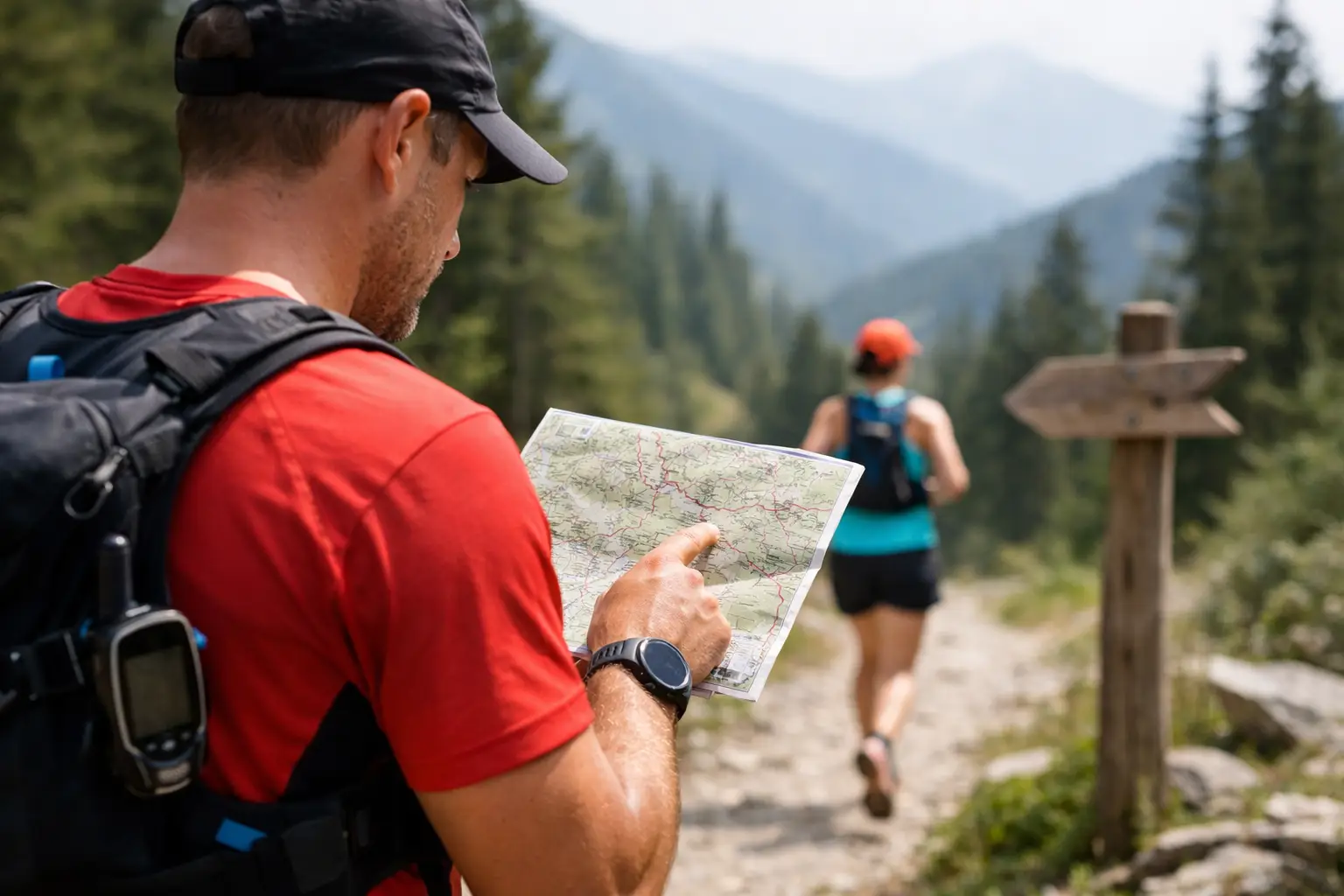
Missing one ribbon can turn a strong race into a long day.
If you want to know how to avoid getting lost in a trail race, start before the gun goes off. Navigation problems rarely come from one big mistake. They usually come from small failures stacking up - poor course study, bad watch setup, wishful pacing, fatigue, and the assumption that race markings will always save you.
Good trail racers treat navigation as part of performance. If you know where the course turns, where the terrain changes, and where the long gaps between aid stations sit, you make better decisions under stress. You move with more confidence, waste less energy, and avoid the kind of detour that can wreck a result.
Why runners get lost in trail races
Most course mistakes happen when speed outruns attention. A fast descent, a crowded start, a foggy ridge, or a late-race mental dip is enough to pull you off line. Even well-marked races can become confusing when intersections stack up or course markings get moved, missed, or hidden by weather and low light.
Another common problem is outsourcing too much trust to the race organizer. Marking quality varies. Some races are excellent. Some are only good enough if you are fully alert. Others rely heavily on local trail knowledge, which helps returning runners and punishes first-timers.
Then there is fatigue. Once your brain is running low, you stop checking basic things. You follow the runner ahead without confirming the route. You forget the next major turn. You assume the wider trail is the correct one. That is how small misses become big ones.
Study the course like it matters
The best answer to how to avoid getting lost in a trail race is simple: know the course before race day.
That does not mean glancing at a race website map once and calling it good. It means understanding the route in a way that holds up when you are breathing hard at mile 38 or climbing in the dark. You want a working picture of the course, not a vague impression.
Start with the full route. Look at the major shape of the course first - out-and-back, loop, figure eight, multiple loops, or point to point. Then identify the places where runners are most likely to make mistakes: trail intersections, road crossings, shared-use trail sections, confusing switchback networks, and any section where the course leaves the obvious path.
After that, connect navigation to terrain. A turn that comes after a steep descent feels different from one that comes in a flat forest section. A junction near an aid station is easier to remember than a random turn in the middle of a long climb. When your brain ties route changes to physical landmarks, recall gets easier under fatigue.
If you have access to a GPX file, use it. If you can inspect the route in 3D and study elevation alongside the line, even better. That lets you understand not just where the course goes, but how it moves through the terrain. That matters when two trail options appear and only one matches the climb or contour you were expecting.
Break the race into navigation segments
Trying to memorize 50K, 50 miles, or 100 miles as one continuous route is a bad plan. Break it into manageable sections based on aid stations, major climbs, ridgelines, creek crossings, or obvious terrain transitions.
Think in chunks. Start to Aid 1. Aid 1 to the saddle. Saddle to the long descent. Descent to the exposed traverse. That structure gives you position awareness. Instead of wondering where you are in the race, you know what section you are in and what should come next.
This also sharpens your error detection. If you think the next segment should be a sustained climb and you are suddenly descending on a fire road, something is off. The earlier you spot that mismatch, the smaller the correction.
Set up your watch before race morning
A GPS watch can save a race, but only if you prepare it correctly. Race morning is too late to learn how course navigation works on your device.
Load the correct route file, confirm it displays properly, and test the navigation screen in training. Know how your watch handles off-course alerts, breadcrumb lines, zoom, battery modes, and rerouting behavior. Some watches are excellent for quick confirmation. Others are slower to interpret on technical terrain. It depends on the device and on how familiar you are with it.
Also think about battery reality, not marketing claims. Navigation, backlight use, cold weather, and long race times all increase drain. If you are racing an ultra, your watch setup should match your expected finish time with margin left over. A dead watch at mile 70 is not a backup plan.
If you use a phone as secondary navigation, download everything for offline use and put it in airplane mode. Do not count on service in the mountains.
Know where race markings usually fail
Not all parts of a course carry equal risk. Look for sections where markings are most likely to be missed.
Intersections are obvious, but they are not the only danger points. Fast descents are a major one because your eyes stay downtrail and your decision window shrinks. Open meadows can be tricky because the trail may be faint and flags may be spread out. Night sections compress your field of view. Volunteer-staffed turns can become vulnerable if you arrive before or after coverage is reliable.
If the race has repeated trail crossings, jeep roads, ski-area access roads, or sections that overlap with other race distances, pay extra attention there. Shared courses create follower error. One runner goes wrong and others copy the move without checking.
Run alert, not paranoid
You do not need to stop at every ribbon and inspect your watch every quarter mile. That kills rhythm. The goal is steady situational awareness.
On race day, keep confirming three things: the last marker you saw, the terrain you expected, and the next feature you know is coming. That mental loop takes only a second when practiced. It keeps you moving fast without drifting into autopilot.
When visibility is poor, or when the course enters a high-risk section, dial attention up. That might mean easing pace slightly into a confusing junction or checking your watch before, not after, a major turn. A few seconds spent confirming direction is cheaper than ten minutes of backtracking.
What to do when you think you are off course
The worst move is denial. If the trail does not match what you expected, act early.
First, slow down and stop the cascade. Look for the last confirmed marker or landmark. Check your watch. Compare the direction of travel with the route line. If you are clearly off course, turn around immediately and backtrack to your last known point. Do not keep moving forward hoping the course will reconnect unless your navigation data supports that.
If you are unsure, make a short check rather than a long gamble. Going 50 yards to confirm a turn is smart. Going half a mile because the trail feels right is how runners lose chunks of time.
In races with mandatory course compliance, cutting back onto the route from an unverified side trail can also create rule problems. Backtracking to the last confirmed point is slower than wishful thinking for one minute, but faster than a disqualification or a major detour.
Use aid stations as navigation checkpoints
Aid stations are not just for bottles and calories. They are reset points.
Before race day, know which trail you leave on from each aid station, whether the exit is obvious, and what terrain starts immediately afterward. Many runners mentally switch off while refueling, then leave pointed the wrong way or miss a nearby turn because their focus is on nutrition.
A simple habit helps: before leaving every aid station, know the next segment. Climb or descent. Singletrack or road. Approximate distance to the next key feature. If you use a platform like TrailSight to organize GPX, elevation, and aid-station data in one place, that review gets a lot cleaner.
Train navigation when you train fatigue
Navigation is a skill, and skills hold up better under stress when practiced under stress. That means using your long runs to rehearse quick route checks, watch use, and terrain recognition when you are already tired.
Practice following a GPX track on local trails. Practice spotting intersections at speed. Practice checking direction without fully stopping. If you know you race poorly in the dark, do some night running with your actual light setup and navigation screens.
This matters even more for runners moving up in distance. The longer the race, the more likely fatigue, weather, darkness, and pace variation will test your awareness. Good navigation is not just a map problem. It is a decision-making problem when your legs and brain are both worn down.
The strongest approach is simple: know the route, know your device, know the danger points, and keep confirming what the trail is telling you. Run it like you have already been there.