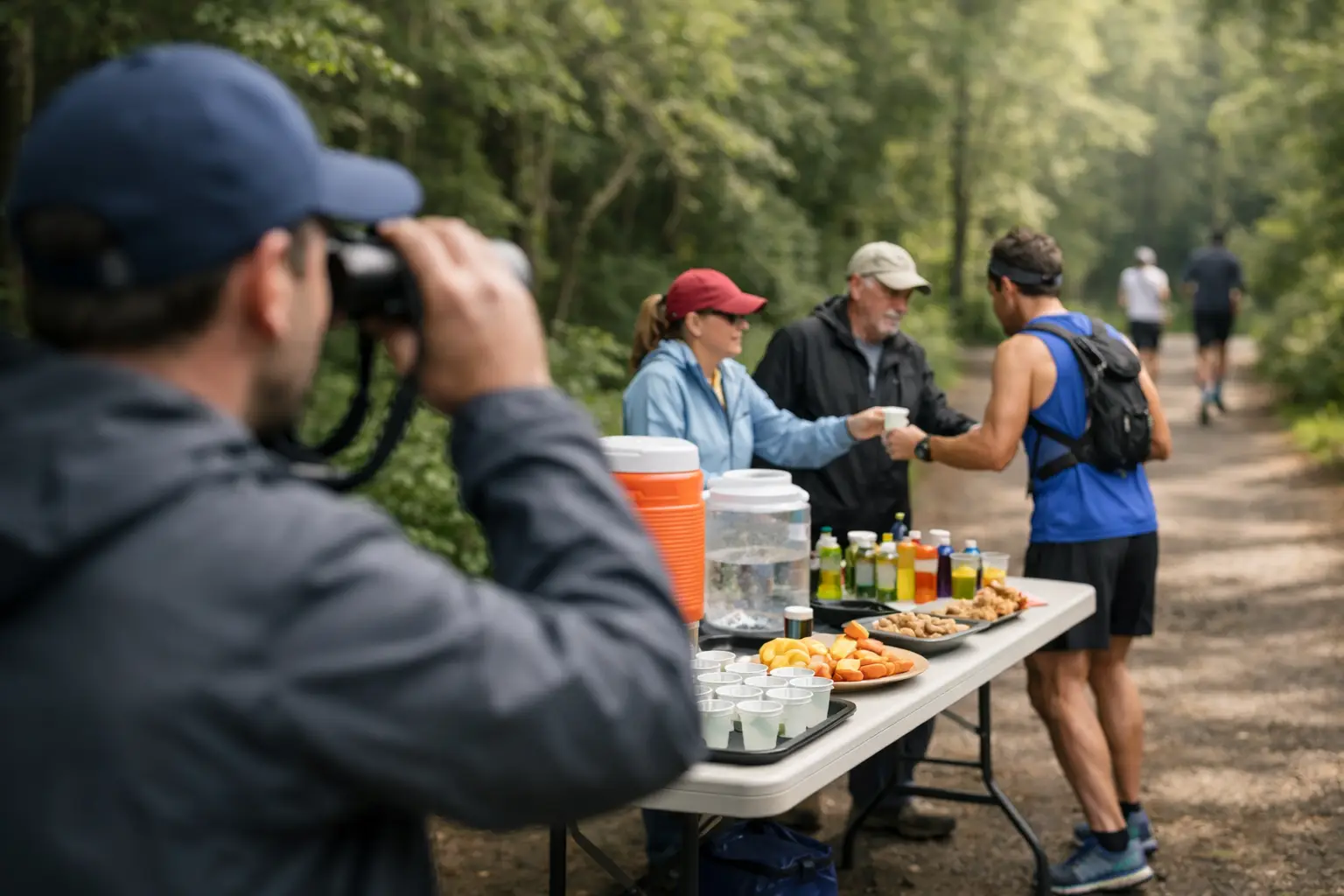
Aid stations are where good race plans either hold together or fall apart. The best way to scout aid stations is not to glance at a race website and memorize mile markers. It is to study each station in context - what comes before it, what happens after it, how long it will take you to get there, and what you will need when you arrive.
That matters more in trail racing than road racing because aid stations are not evenly spaced, terrain changes everything, and a five-mile segment can mean 45 minutes or two hours depending on grade, footing, heat, and altitude. If you scout aid stations by mileage alone, you are planning blind. If you scout them by terrain, effort, cutoff pressure, and fueling demand, you show up with control.
The best way to scout aid stations starts with the segment
Most runners make the same mistake. They look at aid stations as isolated stops. In reality, each one is the end of one segment and the start of the next. That is the frame that matters.
Start by breaking the course into aid-station-to-aid-station segments. For every segment, check four things: distance, elevation gain and loss, expected terrain, and likely time on feet. Distance tells you very little on its own. A short segment with a steep climb and exposed ridge can demand more fluid and calories than a longer runnable section through shaded forest road.
This is why serious course scouting always starts with the route itself. You need to know whether you are climbing into a station depleted or rolling in comfortably. You need to know whether you leave that station for a long descent where you can eat and run, or for a technical climb where fueling gets harder fast.
When you scout this way, each aid station becomes a decision point instead of a surprise.
What to check for at every aid station
Every stop should answer the same practical questions. How long will it take you to reach it? How much water do you need to carry to get there safely? What calories do you need before arrival versus at the station? Is this a quick refill or a full reset?
That last question is where race plans get sharper. Not every aid station deserves the same amount of attention. Some are simple bottle top-offs. Some are critical because they sit before the hottest climb, the longest unsupported stretch, or the section where runners start missing cutoffs.
If the race provides waypoint data, crew access notes, or cutoff times, use them together. A station with crew access, drop bags, and a looming cutoff matters differently than a minor aid table at a backcountry junction. Scout accordingly.
You should also check what the race is actually providing. Water only is different from full food service. Electrolyte drink, gels, broth, ice, and medical support all change your plan. Many runners assume aid station support will match their needs. That is a gamble. Scout the inventory, then decide what you must carry yourself.
Time matters more than miles
A 10-mile road split can be estimated pretty easily. A 10-mile mountain segment cannot. Trail races are won and survived on time awareness, not mileage awareness.
When scouting aid stations, estimate the time between them based on your likely race effort, not your best training day. Be honest about heat, altitude, nighttime slowdown, and traffic on technical trail. If you think a segment will take 90 minutes, build your hydration and calories around 90 minutes plus margin.
That margin matters most late in the race. Small pacing errors compound. Arriving 20 minutes later than planned can mean running low on fluids, missing calories, or reaching a cutoff with no buffer.
Terrain decides what you can actually do
Some segments let you fuel easily. Others do not. A smooth descent or fire road climb gives you room to eat, drink, and settle. A steep scramble, muddy traverse, or rocky descent can shut that down.
That changes how you scout the station before it. If the next segment is highly technical, you may need to leave with bottles topped off, calories already in, and a clear plan to avoid falling behind. If the next section is runnable, you may be able to leave lighter and fuel on the move.
This is the difference between studying a course and understanding a race.
How to rank aid stations by importance
Not all stations carry equal risk. The best way to scout aid stations is to rank them before race day.
Your highest-priority stations usually fall into one of a few categories. They come before the longest gap. They come before or after major climbs. They sit near cutoff pressure points. They mark transitions in weather exposure, altitude, or time of day. They are also the places where your crew, drop bag, or major gear changes come into play.
Once you identify those stations, build a more detailed plan for them. Know your target arrival window. Know what you need to do there. Know what problems you are trying to prevent.
A low-priority station might just mean refill one bottle and go. A high-priority station might mean refill both bottles, grab calories for two hours, swap a layer, reload sodium, and leave with a strict time cap so you do not bleed minutes standing still.
Scout cutoffs with the same intensity as fueling
A lot of runners treat cutoffs as background information until they are suddenly not. That is a mistake.
Aid stations are where cutoffs become real. A station may look comfortable on paper, but if it comes after a technical descent and before a sustained climb, your buffer can disappear faster than expected. Scout where cutoff pressure is most likely to build, not just where the posted times look tight.
This is where segment-based pacing is stronger than generic average pace math. If you know a late-race segment is slow, exposed, and hard to eat through, you can build time earlier or tighten your station stop. If you ignore that reality, you may reach the station feeling fine and still be in trouble.
For serious race prep, aid stations and cutoffs should be viewed together. They are not separate logistics. They are part of the same control system.
Use maps and elevation, not just race charts
Race charts help, but they are not enough by themselves. The best scouting happens when you can actually see where the station sits on the course profile and on the map.
A station at mile 22 means one thing if it is at the base of a climb and another if it is on a ridge after a long exposed ascent. Elevation profiles show demand. Maps show access, terrain shape, and where transitions happen. GPX data and 3D course views go a step further because they help you understand how a station fits into the full route rather than a flat spreadsheet.
That is where a platform like TrailSight fits naturally into prep. Instead of piecing together race PDFs, social posts, and scattered map screenshots, you can inspect the route, check station spacing, review elevation, and connect each stop to pacing and terrain in one place. That is a real advantage when race day gets complicated.
Build your station plan around what can go wrong
Good scouting is not only about the ideal plan. It is about failure points.
Ask simple questions. What happens if it is hotter than expected? What if you miss calories on the climb before this station? What if this segment takes 30 minutes longer than planned? Which station lets you recover that mistake, and which one punishes it?
This is especially important in ultras, where one bad bottle refill or one missed fuel window can echo for hours. The runners who stay composed late are usually the runners who removed uncertainty early.
That means writing down station-specific decisions before race day. Know where you may need an extra flask. Know where you may switch from gels to real food. Know where a headlamp, gloves, or poles become relevant. If you have crew, make your instructions precise. If you do not, make your self-support plan even tighter.
The practical standard for aid station scouting
If your aid station prep stops at mileage, you are underprepared. The practical standard is higher.
For each station, know the segment time, vertical profile, terrain character, likely weather exposure, cutoff relevance, support level, and what your body will probably need at that point in the race. Then decide whether it is a fast pass-through, a controlled reset, or a critical checkpoint.
That is the best way to scout aid stations because it matches how trail races actually unfold. Not in neat mile splits. In long climbs, hard descents, hot ridgelines, slow technical sections, and moments where a two-minute decision can save 30 later.
Know the station before you get there. Know the trail before you run it. That is how you turn aid from a safety net into a race tool.