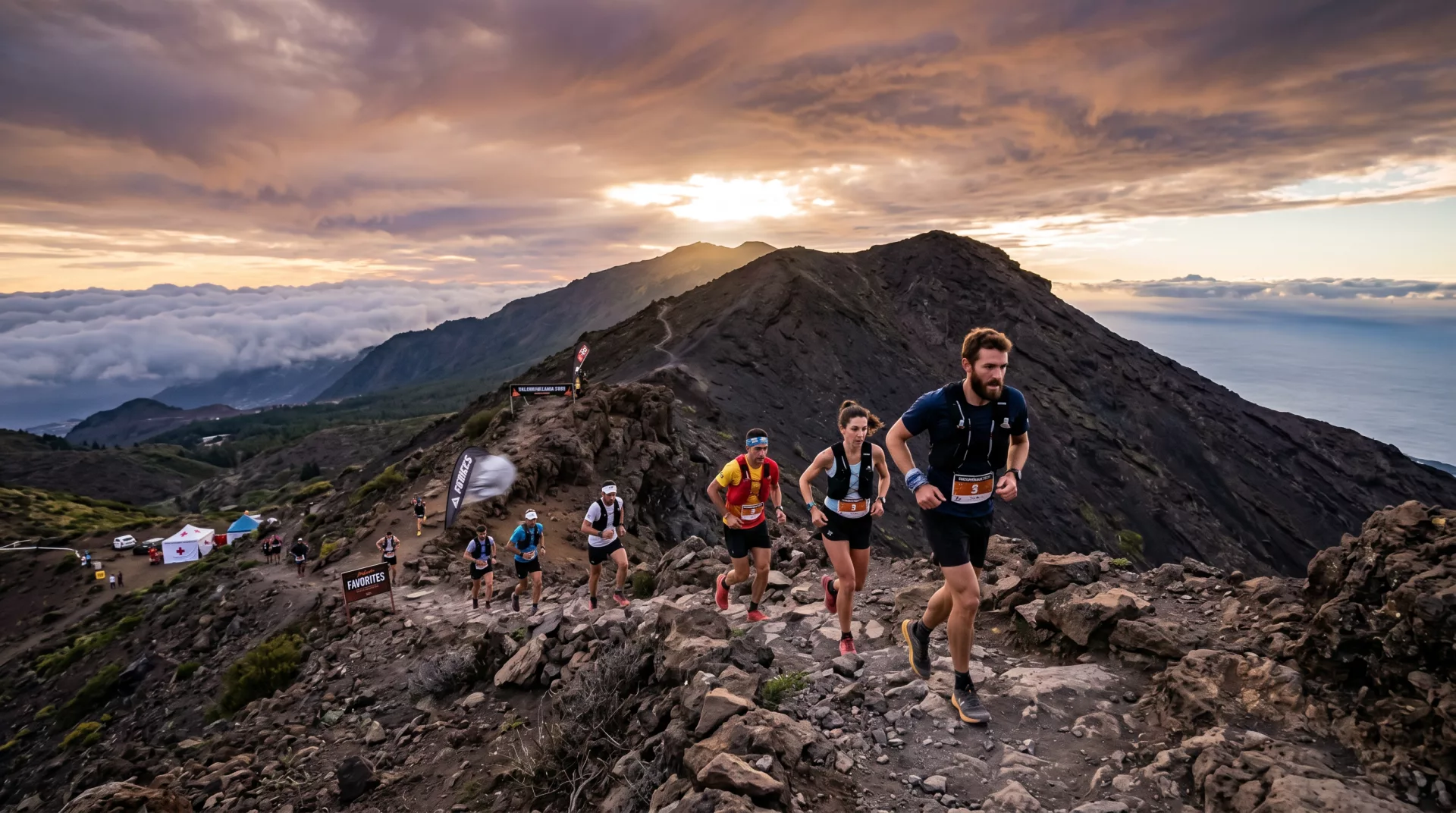
From May 7 to 9, the volcanic island of La Palma hosts the 16th edition of one of trail running's most iconic point-to-point races. With over 3,000 runners from 50 nationalities and a Mountain Running World Cup label on the shorter formats, the Transvulcania Terrex weekend is shaping up as one of the strongest in its history.
The weekend at a glance
Four races share the volcano. The Transvulcania Ultramarathon covers 75 km and 4,350 m of climbing from the Faro de Fuencaliente lighthouse to Los Llanos de Aridane. The Transvulcania Marathon shares the toughest sections in a shorter format. The Half Marathon and the explosive Vertical Kilometer double as official Mountain Running World Cup stops.
Men's ultramarathon favorites
American Ben Dhiman, based in France, headlines the startlist on his Transvulcania debut. He arrives off second place at UTMB 2025, a course record at Lavaredo, and a victory at Grand Raid Ventoux. Italy's Andreas Reiterer returns after a 6:58 runner-up finish in 2025, while Dmitry Mityaev brings three previous Transvulcania podiums (2018, 2019, 2024) and a deep memory of the route. Sweden's Petter Engdahl, the 2022 champion, has sharpened his speed on a recent 2:23 Boston Marathon. American David Sinclair, second at the 2025 CCC, completes a deep top tier.
The men's course record of 6:52:39, set by Luis Alberto Hernando in 2015, has stood for over a decade. Conditions could give it a serious shake.
Women's ultramarathon favorites
Ekaterina Mityaeva is the top returning finisher from 2025, where she clocked 8:36 for second place. France's Blandine L'Hirondel arrives carrying her 2025 Diagonale des Fous victory and a former Trail World Championship title. Australia's Lucy Bartholomew, seventh at UTMB 2025, brings a broad ultra résumé. Two-time winner Emelie Forsberg (Sweden, 2013 and 2015) returns to a course she has shaped before. Ruth Croft's 8:02:49 women's course record from 2024 is the line they will all be chasing.
Half Marathon and Vertical Kilometer: a Kenyan tide
On the men's side, Philemon Kiriago (Kenya), defending Mountain Running World Cup champion and 2025 up and down World Champion, is the man to beat in the Half Marathon. Compatriot Richard Omaya Atuya, runner-up at the 2025 World Championships Uphill, is the headline favorite for the Vertical Kilometer. Spaniard Daniel Osanz, the 2024 Half Marathon winner, will defend Spanish honors alongside VK specialist Andrea Elia (Italy) and Sergio Álvarez (Spain), beaten by twelve seconds in last year's Half Marathon.
The women's race is shaping up as a Kenyan masterclass. Ruth Gitonga, winner of the season opener in São Brás, looks like the overall favorite. Joyce Njeru, fourth in the 2025 Mountain Running World Cup, races both disciplines after winning the Changping Beijing Classic last weekend. Philaries Kisang opens her World Cup campaign on La Palma. Italy's Camilla Magliano, current World Cup leader, brings the season's most consistent form, while Spain's Silvia Lara, second on the VK in 2025, knows every gradient of the climb.
Weather: a textbook spring window
The Saturday forecast points to a classic race day on La Palma. Coastal temperatures sit around 19 to 21°C, with close to twelve hours of sunshine and a moderate northeast breeze near 30 km/h. The catch lives high on the mountain. At the summit of Roque de los Muchachos, 2,426 m above the Atlantic, temperatures can drop to around 5°C and the wind exposure is significant. The trade winds typically pile up clouds against the eastern slope, leaving the western descent dry and sharp under direct sun. A windbreaker and a long-sleeve baselayer stay mandatory on the kit list.
The main difficulties to expect
Transvulcania does not flatter the unprepared. Three sections tend to decide the race.
- Ruta de los Volcanes. The first long climb leaves the lighthouse of Fuencaliente and rises through loose black volcanic sand and exposed cinder cones. Footing is unstable, and the cumulative effort of the 1,800 m climb to El Pilar shapes the entire day.
- The Roque de los Muchachos summit ridge. Above 2,000 m the trail narrows along the rim of the Caldera de Taburiente. Exposure is real and every cardiac effort costs more at altitude.
- The final descent to Los Llanos. From the summit, runners drop more than 2,000 m on the rocky GR-131. Sharp basaltic rocks and pine-forest singletrack test ankles and quads, and this is where leaders crack and mid-pack runners lose hours.
The combination of unstable volcanic ground, altitude, sun exposure on the western slope, and a brutal final descent is what places Transvulcania Terrex among the world's hardest mountain races. The men's gun fires Saturday morning at 6 a.m. local time. The volcano is ready.