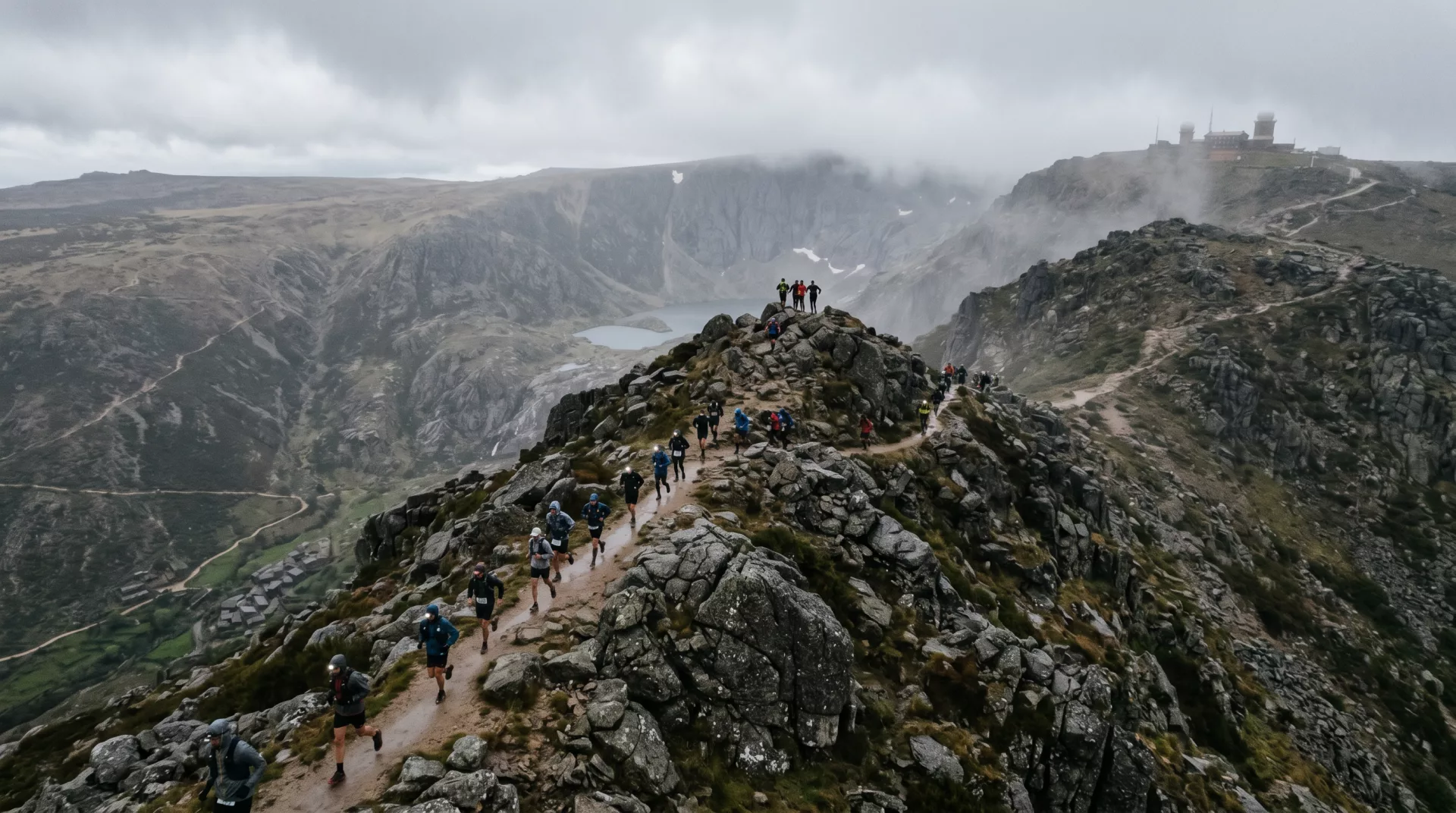
From May 1 to 3, 2026, the 15th edition of Oh Meu Deus by UTMB rolls out of São Romão, Seia, with a new identity. Long known as a stalwart of the Portuguese ultra calendar, the race becomes the first event in Portugal to join the UTMB World Series, gathering close to 2,000 runners from 62 nationalities across four distances in the Serra da Estrela, Serra do Açor and Serra da Lousã.
Favorites to watch
UTMB has not published an official elite start list for the 2026 edition, so the names worth tracking are anchored by the 2025 podium finishers, several of whom have entered again, alongside the international contingent the new World Series status has attracted.
Oh Meu Deus 100M (166 km, 8,900 m D+)
Defending champion Nuno Guimarães (Portugal) returns after winning the 2025 edition in 26:12:22, more than 90 minutes clear of the field. Spain's Félix Parra, runner-up last year in 27:58:17, is back to settle the score, with Portuguese veterans Bruno Daniel Fontão and Miguel Oliveira rounding out the local threat. In the women's race, Marta Abrantes (Portugal) is the woman to beat after her dominant 32:58:29 victory in 2025, ahead of compatriots Elena Vaseva and Cristiana Lagoa.
Oh Meu Deus 100K (90 km, 5,100 m D+)
Ireland's Jamie Sullivan (12:45:43 in 2025) leads a competitive men's field that includes Portuguese ultra-trailer João André Ferreira and French climber Christophe Rachel. The 100K is also the discipline most directly impacted by the World Series upgrade, with several international names crossing borders for UTMB Index points and Running Stones.
Oh Meu Deus 50K (52 km, 2,900 m D+)
The shorter ultra is traditionally the most contested. Defending champion Nuno Paiva (Portugal, 6:39:55 in 2025) returns, with Filipe Correia, Fábio Mendes and José Ramos pushing the home charge. On the women's side, Austrian Yasmin Stoderegger (8:31:53) is the headline name, ahead of Portuguese duo Linda Ladeira and Sara Alves.
Oh Meu Deus 20K (22 km, 1,000 m D+)
The fast Saturday morning race is wide open, but Paulo Palhinha (Portugal) starts as the man to chase after his 2:10:14 win in 2025. France's Camille Fassot, dominant in last year's women's race, is back to defend her title.
Weather forecast
Conditions in the Serra da Estrela are forecast to be cool, damp and changeable across the three days, classic Atlantic spring weather at altitude. Runners should plan for a warmer Friday start followed by a wet Saturday and a cooler, partially showery Sunday.
- Friday, May 1 (100M, 100K, 50K start): overcast, 17 to 19 °C in Seia, very light west wind, no precipitation expected. Comfortable for the early kilometres of the long races.
- Friday night into Saturday morning: dry, 9 to 14 °C, valley fog likely below 1,200 m. The high plateau around Torre will stay cold and damp.
- Saturday, May 2: light to moderate rain through the afternoon (5 to 6 mm), 14 to 17 °C, wind picking up to 15 to 20 km/h. The 100M and 100K front runners will hit the highest ridgelines during this window.
- Saturday night: showers ease, temperatures drop to 8 to 10 °C, humidity above 95%, increasing risk of hypothermia for slower runners on the 100M.
- Sunday, May 3 (20K start): a clearer morning at 8 to 14 °C, then renewed light rain in the afternoon (around 2 mm) and clearing skies overnight, dropping to 6 °C in the highlands.
Mandatory kit requirements should be taken seriously: waterproof jacket, warm layers and a hat are not optional given the forecast and the exposure of the upper Estrela plateau.
Principal difficulties
The course is one of the most demanding in southern Europe, and the new UTMB World Series logo does nothing to soften it.
- Sustained vertical: almost 9,000 m of climbing on 166 km for the 100M, with no single signature climb but a relentless succession of mountain crossings linking the Lousã, Açor and Estrela ranges.
- High-altitude exposure: the route summits Torre at 1,993 m, the highest point of mainland Portugal. The plateau is open, treeless and exposed to wind, fog and sudden temperature drops, especially at night.
- Technical schist sections: the route threads through the historic schist villages of Casal Novo, Talasnal and Candal, where ancient stone paths become slippery and ankle-twisting in the rain.
- Glacial terrain: rocky moraines, granite boulder fields and the high lakes around Lagoa Comprida punish careless footwork.
- Long, dark night: the 100M starts on Friday afternoon and most of the field will run two consecutive nights. Navigation discipline and pacing will decide finishing times.
- Post-fire landscape: parts of the course cross terrain still recovering from the 2022 wildfires, with limited tree cover, exposed soil and dust that can turn to mud quickly under rain.
Live tracking will be available through the UTMB Live platform from Friday afternoon. The first 100M finishers are expected on Saturday evening, with the 20K closing the weekend on Sunday morning.